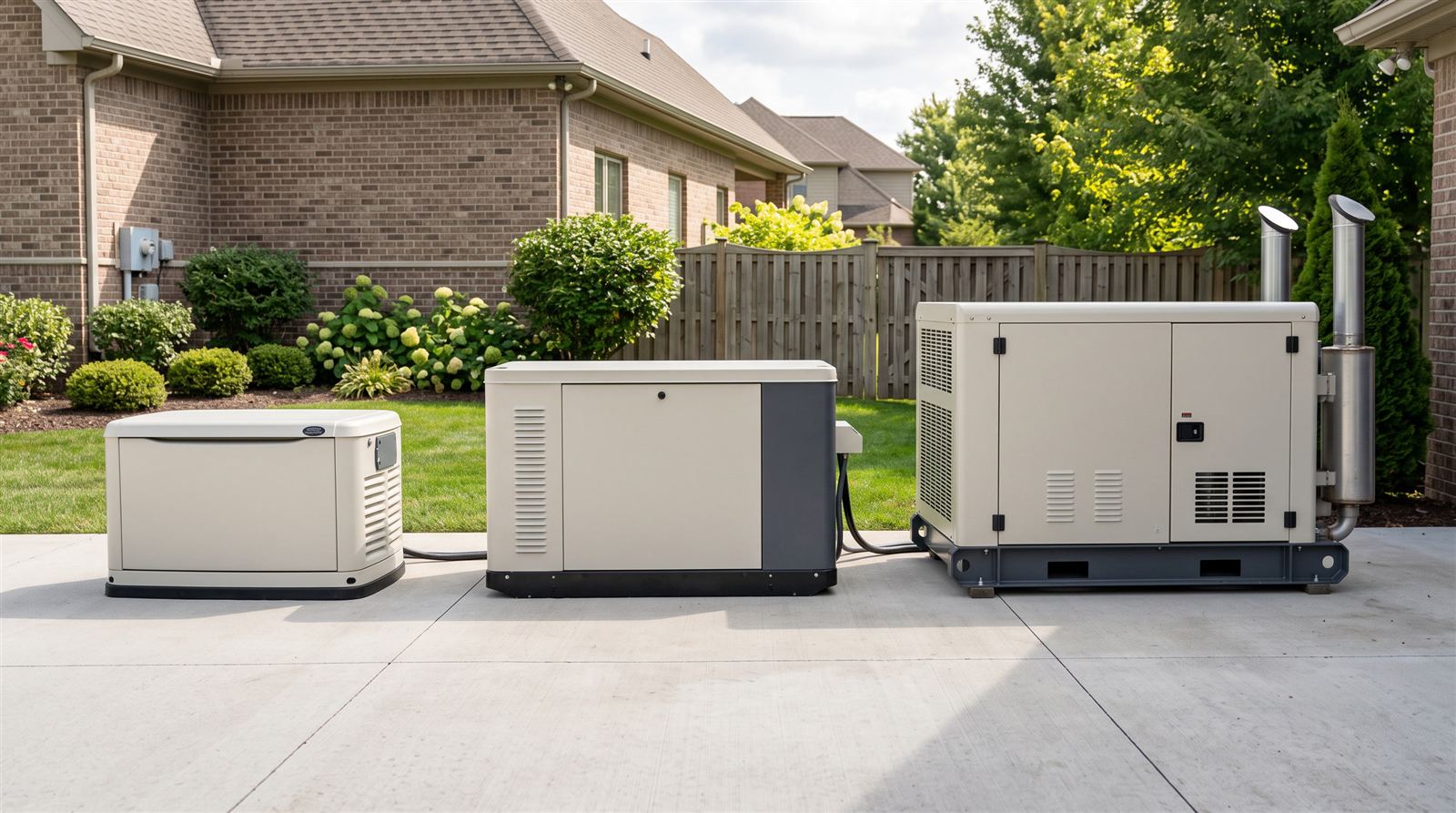
If you live on a small lot, share close property lines with neighbors, or answer to an HOA with noise or placement restrictions, generator noise deserves attention before you fall in love with a specific brand or size. Standby generators are considerably louder than the small inverter generators sold for camping and tailgating, and how much noise reaches your neighbor’s window depends on the specific model, its running load, distance, and even how sound bounces off nearby structures.
Why Standby Generators Are Louder Than You Might Expect
Whole-house standby generators run a full engine, not a small inverter motor, and are designed to sustain meaningful electrical output for hours or days at a time. That means they inherently produce more mechanical and exhaust noise than a small portable unit, even when manufacturers add sound-dampening enclosures. The noise level also changes with load — a generator running near its maximum rated output is typically louder than the same unit idling or running a light load.
Note: always confirm a specific model’s current published decibel rating, along with the load level and measurement distance used for that rating, directly from the manufacturer’s spec sheet rather than relying on general brand reputation or marketing language.
How Brands Generally Compare on Noise
Kohler’s liquid-cooled units are frequently cited by installers and reviewers as running relatively quietly compared to some competitors, which is one reason the brand is often recommended for noise-sensitive installations. Generac has also invested in noise reduction across newer product generations, particularly in its higher-tier lines, though its broader lineup spans a wide range of noise levels depending on model and size. Cummins and Briggs & Stratton both offer models across a range of noise profiles as well, and neither brand’s general reputation should be treated as a guarantee for noise level without checking the specific model’s spec sheet.
| Consideration | What Generally Affects Noise |
|---|---|
| Generator size | Larger units generally produce more noise at full load |
| Cooling type | Liquid-cooled units are often (not always) quieter than comparable air-cooled units |
| Enclosure design | Sound-dampening enclosures reduce noise but vary by model and product tier |
| Running load | A generator working near its max rated output is typically louder than at partial load |
| Placement and distance | Distance from property lines and nearby hard surfaces both affect perceived noise |
Placement Strategies That Reduce Perceived Noise
Even a moderately loud generator can be less disruptive to neighbors if it is placed thoughtfully. Positioning the unit as far as practical from neighboring bedroom windows, avoiding hard surfaces like fences or exterior walls that can reflect and amplify sound toward a specific direction, and using any manufacturer-approved sound-dampening accessories or enclosures can meaningfully change how noise is experienced next door, even without changing the generator itself. Your installer’s site survey should factor in these placement considerations, not just minimum code setback distances.
Checking Local Noise Ordinances and HOA Rules
Many municipalities have general noise ordinances that could apply to a generator’s operation during a self-test or an actual outage, and HOAs frequently have their own placement, screening, or noise-related rules for outdoor equipment. These vary enormously by location and cannot be generalized nationally, so check with your local building department and, if applicable, your HOA’s governing documents before finalizing a generator size and placement plan.
Balancing Noise Against Power Needs
It can be tempting to choose the quietest available option regardless of size, but undersizing a generator to prioritize noise can leave you without power for circuits you actually need during an outage. The better approach is to get a correct load calculation first, then compare noise specifications among the models that meet that size requirement, rather than starting from noise level alone and working backward to a size that may not adequately cover your home.
Key Takeaways
- Standby generators are inherently louder than small portable inverter units due to their sustained full-engine operation.
- Kohler’s liquid-cooled range is frequently cited as relatively quiet, but always verify the current spec sheet for the specific model you’re considering.
- Thoughtful placement — distance from neighboring windows, avoiding sound-reflecting surfaces — can meaningfully reduce perceived noise beyond the generator’s raw decibel rating.
- Check local noise ordinances and HOA rules before finalizing your generator size and placement plan, since these vary significantly by location.
- Get your correct size requirement first, then compare noise specs among qualifying models, rather than choosing the quietest option regardless of size.
Frequently Asked Questions
Which generator brand is the quietest?
Kohler’s liquid-cooled range is frequently cited by installers as relatively quiet compared to some competitors, but exact decibel ratings vary by specific model, load, and measurement distance. Always check the current published spec sheet for the exact unit you’re considering rather than relying on general brand reputation.
Are liquid-cooled generators always quieter than air-cooled ones?
Not always, but liquid-cooled units are often designed with noise reduction as part of their higher-tier positioning, and their enclosures are frequently engineered with more sound dampening. Compare specific models directly rather than assuming cooling type alone determines noise level.
Can generator placement really make a difference in perceived noise?
Yes. Distance from neighboring windows, avoiding hard surfaces that reflect sound toward a specific direction, and using manufacturer-approved sound-dampening accessories can meaningfully change how noise is experienced by neighbors, even without changing the generator’s raw output level.
Do HOAs typically restrict generator noise or placement?
Many do, but rules vary enormously between communities and cannot be generalized. Check your HOA’s governing documents and your local municipality’s noise ordinance before finalizing your generator size, model, and placement plan.
Should I choose a smaller, quieter generator to reduce noise?
Not if it means undersizing for your actual electrical needs. Get a correct load calculation first, then compare noise specifications among the models that meet that size requirement, rather than sacrificing needed capacity purely to reduce noise.