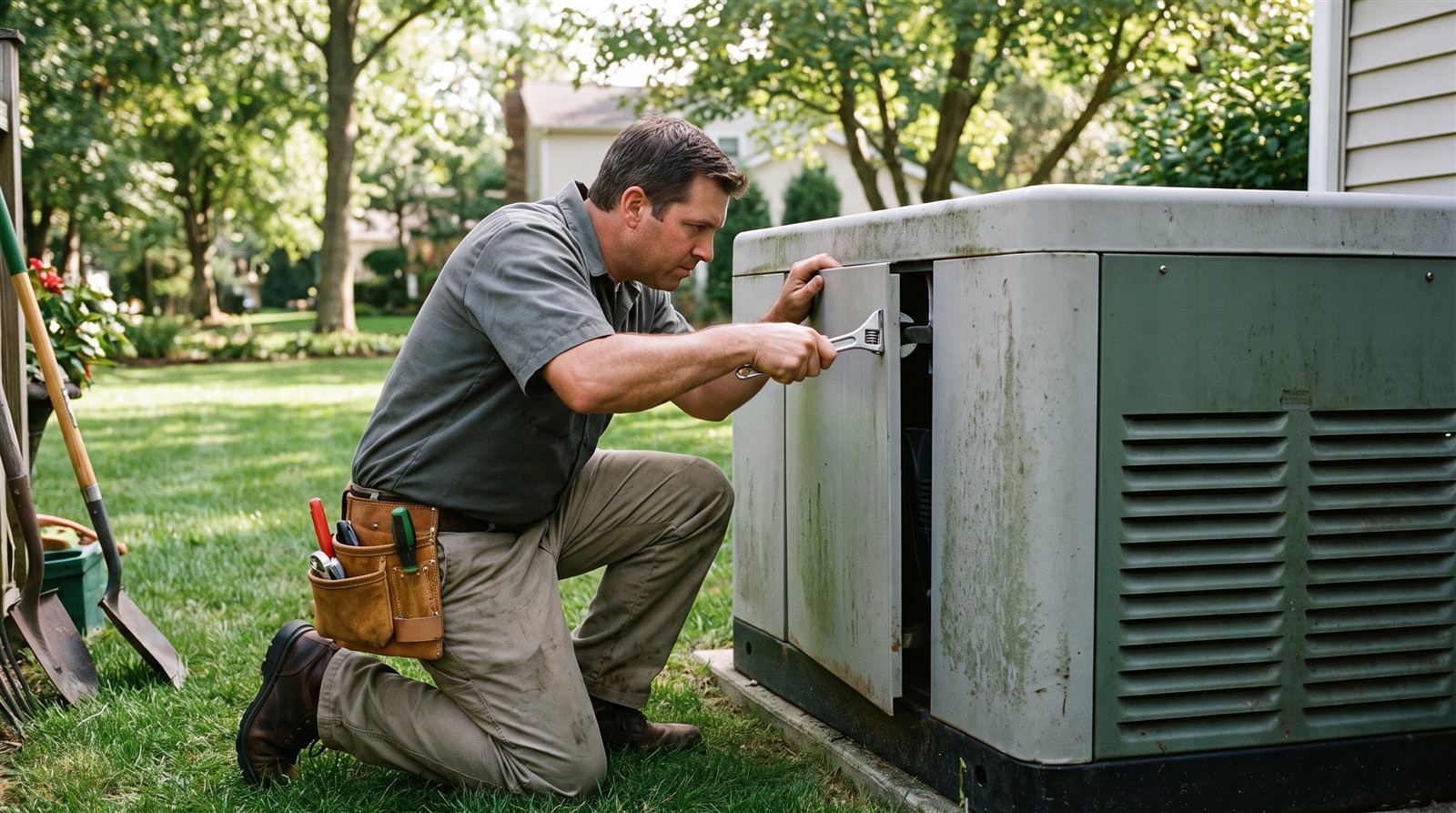
Few things are more frustrating than a power outage hitting and discovering your standby generator isn’t starting the way it’s supposed to. Before assuming the worst, it helps to know that a number of the most common causes are simple, safe checks a homeowner can perform themselves, while others clearly signal it’s time to call a professional rather than keep troubleshooting on your own. Working through the basics in order can often get you back up quickly, or at least tell you clearly that this is a job for a technician.
Start With the Safe, Simple Checks
Before assuming a major mechanical problem, rule out the simplest explanations first. These are checks any homeowner can safely perform without opening up the generator or touching its electrical components.
Step-by-Step Troubleshooting Process
- Check the generator’s run/auto/off switch: confirm the switch on the unit itself is set to “Auto.” It’s easy for this to get bumped or switched during yard work or a prior service visit.
- Look for a fault or alarm code on the control panel: most modern standby generators display a specific code or message when something is preventing startup. Note the exact code, since it will help a technician diagnose the issue quickly if you need to call one.
- Check the fuel supply: for propane, verify the tank isn’t empty and the supply valve is open. For natural gas, confirm there isn’t a separate manual shutoff valve near the generator that’s been closed.
- Check for a tripped breaker: look for a tripped circuit breaker dedicated to the generator’s control circuit or battery charger, often located in your main panel or a small breaker box near the unit. Reset it once, following manufacturer guidance, and see if that resolves the issue.
- Inspect the battery connections: a loose or corroded battery terminal is a common, low-cost cause of no-start conditions. If you’re comfortable doing so, visually check that connections are tight and free of corrosion, but avoid disconnecting or working on the battery itself unless you know how to do so safely.
- Check the automatic transfer switch position: confirm the transfer switch hasn’t been left in a manual or test position from a prior service visit, which can prevent it from properly detecting a utility outage.
- Listen for the engine attempting to crank: if the engine tries to start but doesn’t catch, this points toward a fuel delivery or ignition issue rather than a dead battery or electrical fault, which is useful information to relay to a technician.
- If nothing above resolves it, stop and call a professional: repeated start attempts without addressing an underlying fault can sometimes trigger a lockout mode on the control panel as a protective measure, and continuing to force restarts is not a substitute for diagnosing the actual cause.
What a Lockout Code Means
Many standby generator control panels will lock out after a set number of failed start attempts, displaying a fault code and requiring a manual reset, sometimes only by a technician depending on the model and the underlying fault. This is a deliberate safety and protection feature, not a malfunction in itself. If your unit shows a lockout code, resist the temptation to keep cycling the start switch; note the code and call your service provider, since repeated attempts can occasionally complicate diagnosis or, in some fault conditions, cause additional strain on the engine.
Common Underlying Causes a Technician Will Check
If the basic checks above don’t resolve the issue, a technician troubleshooting a no-start condition will typically look at battery health and charging system performance, fuel pressure and delivery, spark or ignition components depending on engine type, the control board itself, and the wiring between the transfer switch and the generator. Because standby generators combine a fuel system, an engine, and electrical components tied directly into your home’s panel, diagnosing beyond the basic checks above is genuinely a job for someone trained and equipped to do it safely.
Preventing No-Start Problems Before They Happen
Most no-start emergencies trace back to something that could have been caught during a routine weekly self-test or annual service visit: a battery that was already weakening, a fuel valve that got closed during yard work and never reopened, or a fault code that had been showing for weeks unnoticed. Paying attention to the weekly self-test, rather than assuming it’s fine because you don’t hear about it, is the best long-term defense against discovering a problem for the first time during an actual outage.
Key Takeaways
- Start with simple checks: the run/auto/off switch, fuel supply, breakers, and battery connections, before assuming a major failure.
- Note any fault or alarm code exactly as displayed; it’s valuable information for a technician even if you can’t resolve it yourself.
- A lockout after repeated failed start attempts is a protective feature, not something to keep cycling through on your own.
- Avoid opening up the generator’s electrical or fuel components yourself; these checks are best left to a qualified technician.
- Paying attention to weekly self-test results is the best way to catch developing problems before they become an outage-day emergency.
Frequently Asked Questions
My generator’s control panel shows an error code. What should I do?
Write down the exact code or message displayed, then contact your generator’s service provider or manufacturer support line. Having the specific code ready significantly speeds up diagnosis, whether it’s handled over the phone or during an in-person visit.
Is it safe to keep trying to restart the generator myself?
A reasonable, limited attempt following the switch and fuel checks described above is generally fine. Repeatedly cycling the start switch after a lockout code appears, however, is not recommended, since it’s often a signal that the control system has intentionally stopped attempting to start due to a detected fault.
Why did my generator work fine during its last weekly self-test but fail during the actual outage?
This can happen when a fault develops between test cycles, such as a fuel valve being closed after the last successful test, a breaker tripping, or a battery that was borderline and finally failed under the demand of an actual outage. It’s one of the reasons some homeowners choose connected models that send alerts if a self-test doesn’t complete successfully.
Can cold weather cause a generator not to start?
Yes, cold temperatures can affect battery performance and engine oil viscosity, which is part of why many standby generators include a block heater or cold-weather kit in colder climates. See our winterizing checklist for cold-weather-specific preparation steps.
How quickly can a technician usually respond during a widespread outage?
Response times often slow down during large regional outages simply because many households are calling for service at the same time. This is one more reason routine maintenance and prompt attention to fault codes between outages matters, since it reduces the odds you’ll need emergency service exactly when technicians are hardest to reach.